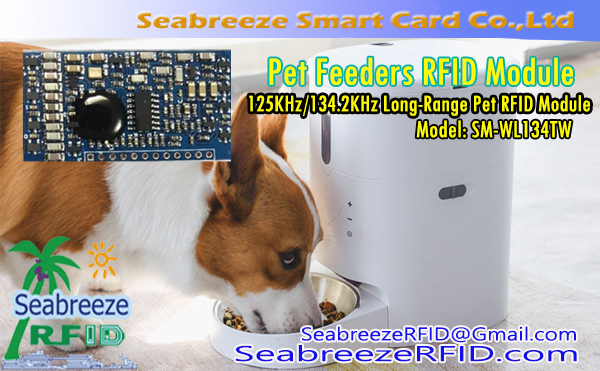
To make caring for their pets more convenient, pet owners often choose to purchase smart pet devices, such as automatic feeders and smart water dispensers. Walakini, these devices share a common drawback: they cannot accurately identify each pet’s identity, making it impossible to ensure that every pet receives the appropriate amount of food. During feeding, pets may compete for food. If a particular pet is on a diet or requires a specific diet for medical reasons, such competition can lead to failed weight loss efforts or illness caused by consuming the wrong food. Kwa hiyo, the SM-WL134TW module is a low-frequency, long-range RFID module designed for smart pet devices. By integrating this RFID module into smart pet devices, it effectively solves the problem of inaccurate identification, providing technical support for intelligent pet feeding. RFID technology, or Radio Frequency Identification, enables contactless identification and data exchange via radio frequency signals. Its core principle involves information exchange between an RFID reader or module and an RFID tag. Each RFID tag is unique; this uniqueness (equivalent to assigning a unique “ID card” to each pet) allows for the effective and precise identification of each pet’s identity. The SM-WL134TW is a low-frequency, long-range RFID module designed for smart pet devices. It supports dual operating frequencies of 125kHz and 134.2kHz and can read RFID tags in FDX-B and EMID formats. It offers a reading range of ≥30cm for pet collar chips and ≥15cm for implantable glass tube chips (2× 12mm). It offers core advantages such as high reading sensitivity, matumizi ya nguvu, fast speed, long range, no blind spots, and zero missed reads. It is widely applicable in smart pet devices (such as automatic pet feeders, smart litter boxes, and smart water dispensers) and livestock farming scenarios (including poultry leg band reading, animal ear tag reading, and fish tracking tags). Implant a glass tube RFID chip (1.25x7mm, 1.4x8mm, or 2x12mm) into the pet or attach an RFID chip to its collar. Enter important information such as the pet’s age, gender, breed, and name into the RFID tag to link it to the pet’s identity, serving as a form of identification. Integrate the RFID module into smart pet devices. When a pet approaches the device, the RFID module reads the pet’s identification information and sends it to the main control unit. Upon receiving and verifying the pet’s identity, the main control unit triggers the feeder or water dispenser to operate, while simultaneously recording the pet’s feeding data. Application scenarios for the SM-WL134TW module in smart pet feeding devices:
1. Automatic Pet Feeder When a pet approaches to eat, the RFID module reads the chip on the pet’s collar or the implanted glass tube chip. After verifying its legitimacy, the automatic feeder opens the lid and dispenses food. If the tag information read by the RFID module is invalid or no tag is detected, the feeder automatically closes the lid, enabling personalized feeding while preventing other pets from stealing or competing for food.
2. Smart Pet Water Dispensers When a pet approaches to drink, the smart water dispenser activates water flow after the RFID module reads the tag information. Water flow stops once the pet leaves the RFID module’s reading range. The system also records key information such as the time, Mara kwa mara, and volume of each drinking session, helping to promptly identify abnormal behavior and ensure the pet’s health.
Kuu Ufundi Vigezo Frequencies: 125KHz and 134.2KHz Support itifaki: EMID, FDX-B, ISO11784 / 11785 Lebo za usaidizi: EM4305, HITAG256, TK4100, EM4100, EM4200, EM1001, T5557, T5577,etc. voltage: 3.3~6V Electric current: 90mA@5V, supports shutdown mode Communication Port: UART TTL Signal indication: blue LED indicator light Kazi joto: -20° C ~ 70 ° C size: 26.5X50X3mm Uzito: 7g (This module is available in a MODBUS RTU version)




 Fung
Fung
 Meneja wa mauzo